Talk inside the chat
The account replies to group members' messages instead of leaving comments under channel posts.
Neurochatting is AI-run accounts talking in Telegram group chats. It is often confused with neurocommenting, a chat bot and AI dialogs: each works in its own place and does its own job. Below are the definition and the comparison tables.
In short
Neurochatting is the work of Telegram accounts run by AI that read group chats and reply in them as ordinary members: on triggers, at a fitting moment, or by starting a new topic. It differs from neurocommenting by place (a chat, not the comments under a post), from a chat bot by writing from a person's account, and from AI dialogs by working in a group, not in private messages.
TeleTraff editorial teamUpdated: Checked in the panel
The account replies to group members' messages instead of leaving comments under channel posts.
The text follows your instructions and the latest chat messages, not a ready script with buttons.
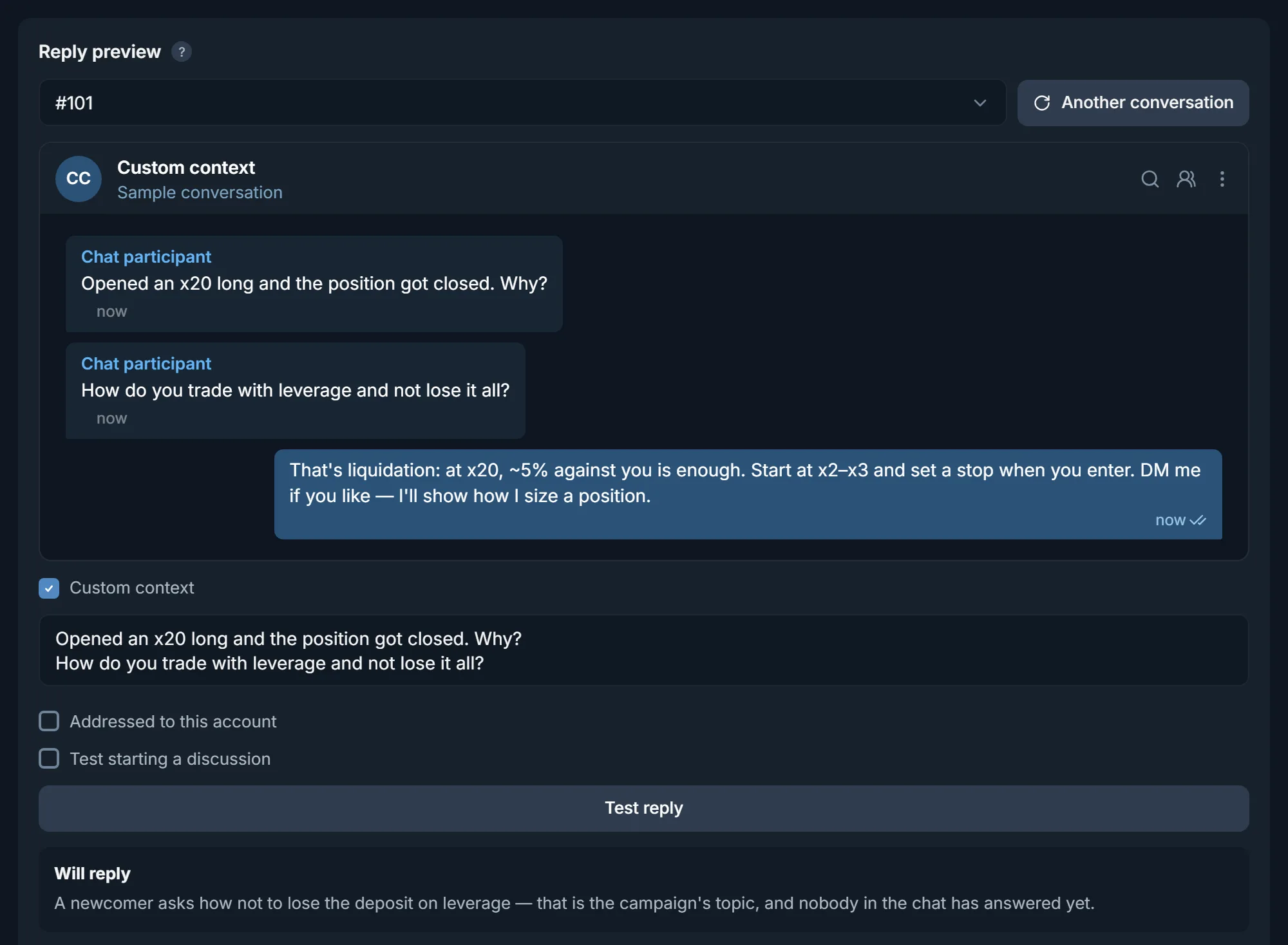
«Reply preview» shows whether the account would reply and sends nothing to Telegram.
Neurochatting is running Telegram group chats with accounts and AI. An account is a member of the chat, reads the latest messages and decides for itself whether to join the conversation. The message goes out from the account as an ordinary member's reply. The work is made of three actions.
In the panel this is done by the Neurochat module. A campaign is made of accounts, target chats and modes. Chats come «From a list» or from the accounts' own memberships. There are three modes: «On triggers» (words and meaningful situations), «Join conversations» (on by default) and «Start discussions» with an interval for new topics in minutes.
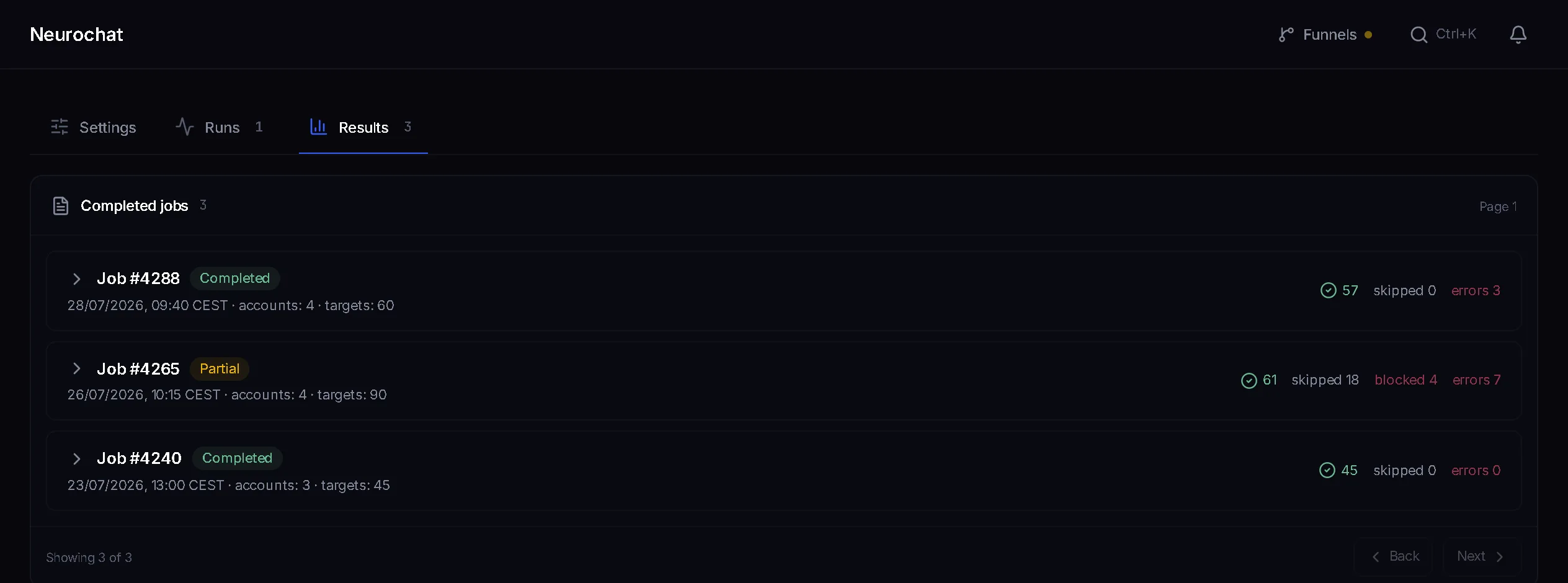
The run results count «Read», «Reply decisions» and «Confirmed» separately. An AI decision does not count as sending: only a reply the panel found in the chat is counted.
| Feature | Neurochatting | Neurocommenting |
|---|---|---|
| Where it works | In group chats the account belongs to | In the discussion under channel posts |
| What triggers a reply | Members' messages: a trigger, a fitting moment or a topic of its own | A new channel post. Posts are chosen by the «New only», «Existing» or «Existing first» mode |
| What the AI reads | The last 20 chat messages, up to 80 | The post text; posts are filtered by words, probability and minimum length |
| Accounts per target | One per chat; up to 100 with «Several accounts in one chat» on | Set by «Accounts per channel» and «Comments per post», 1 and 1 by default |
| What the audience sees | Replies in the live conversation of the group | A comment in the thread under a post; «Autoresponder» answers people in the same thread |
| Module in the panel | «Neurochat» | «Neurocommenting» |
If you need to write under channel posts, you need neurocommenting. Neurochatting does a different job: it holds a conversation inside a chat.
A chat bot in Telegram is a separate account type. It is created in BotFather, carries a «bot» label, cannot message a person first, and in a group sees only commands and messages addressed to it by default. That is Telegram's own behaviour. Neurochat does not work with bots: it needs ordinary accounts.
Answers commands, buttons and menus. Fits taking requests and giving reference answers.
An ordinary account with a session. Writes free text composed by the AI.
A bot works without a user session. An account needs both a session and a proxy.
Dialogs is the module for private messages. A campaign replies to people who wrote to the account themselves («Everyone who writes») or to people a mailing wrote to («Only people the mailing wrote to»). A conversation is divided into «Conversation stages», up to 10 of them, and the campaign remembers the person in the «What to remember about the person» block.
Neurochat can also reply in private messages. The «Private conversations» block hands such conversations to a Dialogs campaign: «Related to this campaign» or «All new incoming conversations». Then a person the account answered in the chat carries on in private messages under the Dialogs rules.
| Task | What fits | What it looks like |
|---|---|---|
| Crypto chats for beginners: answering questions about leverage and stops | Neurochatting | The «On triggers» mode with words about leverage and liquidation |
| An infoproduct announcement went out in a channel and needs a live thread | Neurocommenting | Posts in the «New only» mode, comments under each one |
| A person from a chat messages privately asking how to buy VIP access to picks | AI dialogs | A Dialogs campaign with stages and a dossier on the person |
| Taking traffic audit requests by command and button | Chat bot | Menus and buttons inside Telegram, Neurochat takes no part |
| A betting chat is quiet and needs a background of several voices | Neurochatting | «Several accounts in one chat», each with its own persona |
Terms on this page
It is talking in group chats with accounts that an AI answers for. The account reads messages, decides whether to reply and writes a line in its own name.
No. Neurochatting works in group chats and replies to members' messages. Neurocommenting writes in the discussion under channel posts. In the panel they are two different modules.
The «Join conversations» mode is on by default: the account replies to messages. If you turn on «Start discussions», the account opens new topics itself at an interval you set in minutes.
No. AI by TeleTraff runs by default. You connect your own key on the AI page in Settings with the «Use my own API key» switch.
Yes. «Reply preview» takes a sample conversation or your own context and shows a verdict: «Will reply», «Will skip» or «Will wait for more context». Nothing is sent to Telegram.
Look at «Confirmed» in the run results. «Read» and «Reply decisions» do not prove sending, while a confirmed reply is one the panel found in the chat.
Read next
More in this section
Other sections
Sign up, connect accounts and check a reply in the preview before launch: Trial gives 3 days for free.